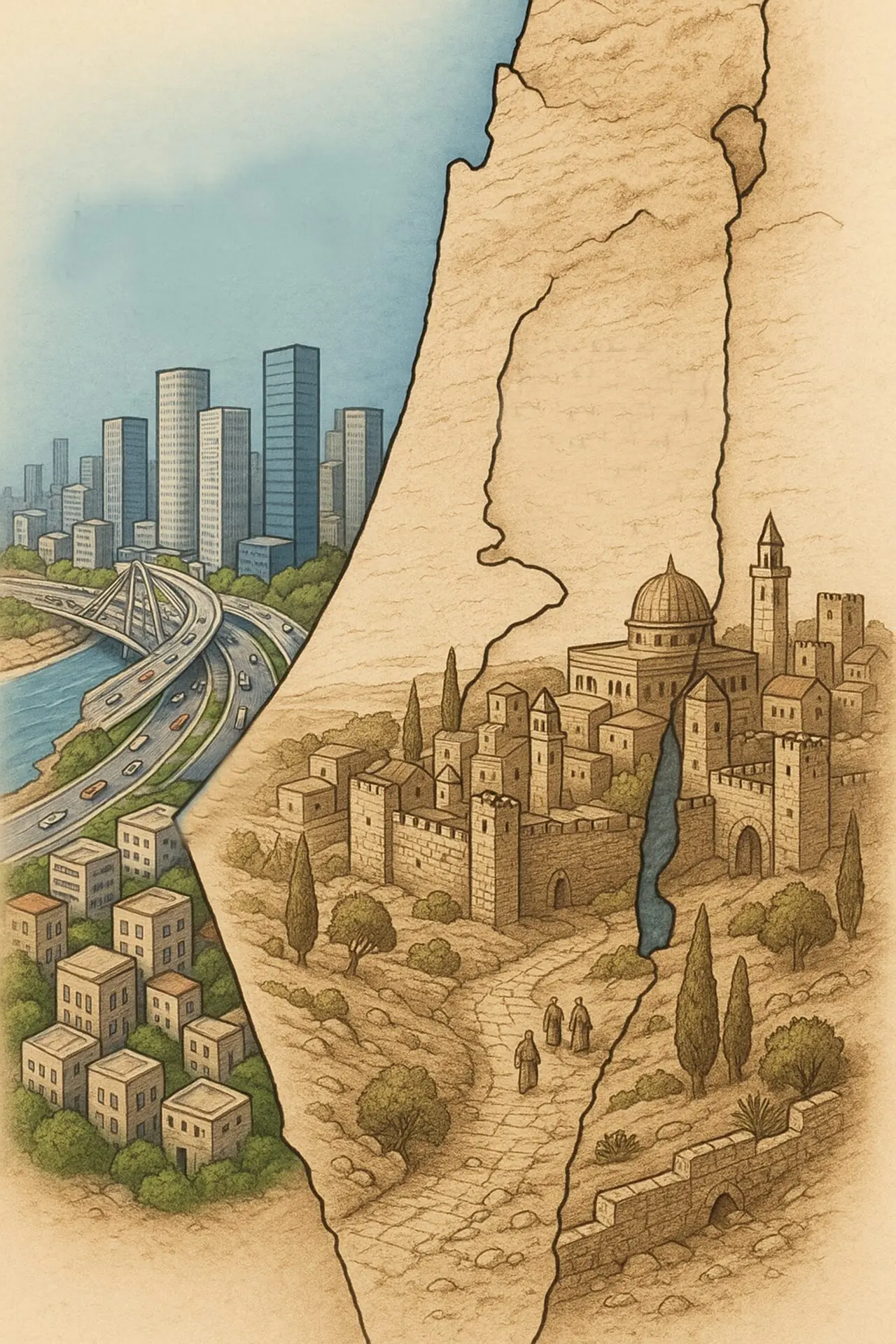
Is Modern Israel the Same as Biblical Israel?
This may be the most emotionally charged question the Church has ever faced. On the one hand, most Bible-focused Christians support Israel, believing the renewed 77-year-old nation fulfills prophecy as more than half the world’s Jews are living there now, a key factor in the prophetic model.
Yet, another segment of the Evangelical community is having doubts, clearly fueled by the war in Gaza and claims of genocide in the press. Daily reminders of the suffering portrayed in the Gaza strip have cast a shadow over the long-held belief within Evangelical Christian circles, that modern-day Israel is indeed a fulfillment of prophecy.
Let’s not even discuss where historical Christianity stands, as the vast majority of the estimated one billion citizens of the world who identify as Christians do not hold a positive view of the modern state of Israel.
To answer the question biblically, why not look at the Scriptures for some guidance?
Genesis 12:2-4 explains that indeed, through Abraham, all the families of the Earth would be blessed. When seen through the lens of all three of Abraham’s wives, including Sarah, Hagar and Keturah, God’s blessings have flowed to all peoples.
To begin with, the Bible directs God’s blessings, and inheritance of the Land of Israel through Abraham and Sarah’s son Isaac, who in turn would receive the promise. Note the text in Genesis 17:18-21 where God says it will be Sarah who will bear a son, Isaac and through him establishing the everlasting covenant. In turn Ishmael will also be blessed but will not carry the Messianic seed line nor is he destined to inherit the land.
Genesis 25:1-6 explains details of Abraham’s marriage to his third wife Keturah, and their offspring. It can be argued these sons and grandsons complete the other Middle Eastern peoples who, we believe, have intermingled with Ishmael’s clans in essence creating the foreshadowing of the modern Arab world. But they are not the promised seed.
The blessing now extended through Isaac, incorporating Isaac’s son Jacob as explained in Genesis 35:9-12. This passage picks up Jacob’s name change to Israel and clearly spells out the line of succession of the Messianic seed line and inheritance of the Land through Abraham’s grandson Jacob, not his twin brother Esau. Now that we have the biblical account aligned with Abraham through Isaac and Jacob how does this fit into the overall history of the Jewish right to the Land and the other covenants God has cut with His people?
We also know that God only cut five of His eight covenants with Israel, up to and including the new Covenant (Jeremiah 31), which guarantees Israel’s forever status.
Between the 8th Century and 7th Century BCE, tens of thousands of Jews were exiled by the Assyrian and Babylonian empires to foreign lands, leading them to Persia, Babylon, and Asia. Post exilic prophets such as Ezra, Nehemiah, Zechariah and Haggai document Israel’s first return to the land. We also have surviving historical records through the Apocrypha and the books of the Maccabees, and finally the New Testament records.
Moving up the timeline a bit, after Rome sacked Jerusalem and the Temple in AD 70, during the Jewish Wars, more than a million lost their lives, while others were scattered throughout the Roman Empire as slaves. Jewish blood now ran through the veins of the European continent, not to mention through parts of Asia and of course the Middle East. The Crusades and later the Spanish Inquisition forced Jewish citizens out of their homes to other nations. Even during those centuries of turmoil, there has always been a continual Jewish presence in the Land.
History tells us there are two major Jewish lines. The indigenous Jewish peoples of the Middle East, the Sephardic Jews, populated Arab lands, North Africa, and other areas in the Levant. Many are of darker skin, speak everything from Arabic to Persian, and nearly every language known to man. The second strain is the Ashkenazi Jewish presence, mostly coming from Eastern Europe in modern times, but originating from Judean Jews (read biblical Jews).
To answer the question historically, why not look at some historical guidance?
Whether pursued by antisemitic Christians through the Middle Ages, Muslim invaders through the centuries in their homelands, or 20th Century dictators, the Jewish people remained loyal to their identity and culture, no matter how much they may have fallen short in their sin. Their eternal hope to return to their ancient homeland burned deep within them.
Jewish immigration spread throughout Europe, Asia Minor, and eventually across the seas to America, often due to persecutions throughout Europe. One such incident, the Dreyfuss Affair, surfaced deeply held antisemitic hatreds in France, which in turn sparked the modern Zionist movement.
In 1896, Austrian Journalist Theodore Herzel, wrote extensively in defense of Dreyfuss, a French army officer accused of treason. From that, he published Der Judenstaat, reviving Jewish hopes for the eventual return to their ancient homeland. The book sparked a revival among those Jews who sought to reestablish the Jewish nation from the dustbin of history. Within 50 years, Herzel’s dream became reality.
In 1917, The British government published the Balfour Declaration, guaranteeing a Jewish homeland in historical “Palestine”. Further, international agreements following World War 1 by the League of Nations, the British Mandate for Palestine, and the San Remo Conference set apart a parcel of land for the Jewish people. Following that, the 1947 United Nations partition vote ushered in the modern state of Israel (May 14, 1948), much to the chagrin of their Arab neighbors.
Perhaps the most important question facing believers is this: Since modern day Israel is not in a state of belief and sin is rampant, has God abandoned them? The wise and insightful seeker need only ask this… Do you believe God makes and keeps His promises? Was the Abrahamic covenant dependent on Israel’s loyalty and obedience or was it dependent on God alone?
So, if Israel has lost its blessings because of sin, can the same be said for the Church? Does this mean when God gets mad, He abandons His promises? Absolutely not! Paul expresses this in Romans 11, not to mention words written by Hosea which promise that even though God may turn His back on Israel, it is only for a short time before He brings them back into fellowship with him (Hosea 14:4.)
Except for the Mosaic Covenant, which by nature was temporary, every other covenant was enacted and kept by God alone. Asking the same question, but in reverse, has Christianity lived up to its lofty expectations? Has it fulfilled its mission to love the Jewish people, especially as detailed in Romans 9-11?
What does New Testament have to say about Israel? In his seminal work Israelology, Dr. Arnold Fruchtenbaum identifies more than 70 citations of Israel in the New Testament, each related to the physical descendants of the ancient Jewish people. In other words, Israel in the New Testament speaks of physical, ethnic Israel. Nowhere in the New Testament does the Church replace Israel, as long as we adhere to a consistent grammatical, historical and contextual method of interpretation.
So, is today’s Israel the same as Biblical Israel? Are today’s Jews descended from their ancient ancestors?
From God’s covenantal promises to His chosen, from the Rabbinical community’s efforts, to the preservation of the Hebrew language and Jewish culture all have helped preserve a means of connecting Israel’s past to its present.
To answer the question archeologically, why not look at the Dead Sea Scrolls for some guidance?
Today, the Hebrew language is spoken as a modern language, the first time in modern history an ancient dead language–only used for prayers and liturgy– has been revived. Hebrew readers in Israel can read and understand the ancient texts discovered in Qumran (the Dead Sea Scrolls) in 1947, just as easily as they can read their daily newspapers. Additionally, Israel’s history is literally being dug out of the ground as we speak. Ancient cities, coinage, weapons, pottery, and a host of other antiquities have kept archaeologists busy for decades.
From Jewish hating peoples from the Middle Ages down through the Holocaust and to today’s Middle East despots, the Jewish people remain intact and for the first time in 2,000 years, live in their own land and speak their original language.
Does Israel have the right to exist as a modern-day expression of an ancient past?
Absolutely!
Does modern Israel truly represent today’s Jews in the same way ancient Israel did?
We believe so. There is evidence from the Bible, from the ground and from history through international agreement.
The Abrahamic Covenant established the boundaries and ownership of Land of Canaan as the future home of the Jewish people, delivered through Abraham, Isaac, and Jacob and his descendants. It is as intact today as it was then.
Ezekiel’s words (Ezekiel 36:24-32) promise the return of the Jewish people form the worldwide dispersion in unbelief, followed, by God breathing His Spirit into them. So, supporting Israel from a biblical, historical AND archeological perspective makes total sense.
The Scriptures are clear; modern day Israel indeed is the fulfillment of the prophecies of the Tanach and the future is bright and glorious for Israel (Zechariah 8:20-23.)




I want to understand the new antisemitism so that I can work effectively against it as I have been doing all my life.
I will also continue working with Alijah.
Excellent article - 100% agree.
We must remember Ezekiel 36
Gby
I have a question about this paragraph from your article:
"History tells us there are two major Jewish lines. The indigenous Jewish peoples of the Middle East, the Sephardic Jews, populated Arab lands, North Africa, and other areas in the Levant. Many are of darker skin, speak everything from Arabic to Persian, and nearly every language known to man. The second strain is the Ashkenazi Jewish presence, mostly coming from Eastern Europe in modern times, but originating from Judean Jews (read biblical Jews)."
Are the covenant promises of God to Abraham, Isaac, and Jacob extended to both strains of Jews (Sephardic and Ashkenazi), or just to Ashkenazi?, read "biblical Jews." Please pardon my confusion on this point.
They Are for all Jews
Thank you for the clarification. That's what I thought. God bless Israel.
Well said. You can trust Oliver. I know of him and listen to and watch his work especially when he is with Tom Hughes - another one to follow and pay attention to. You will find plenty of Tom Hughes analysis and commnetary along with Oliver Melnick's (pronouced Mel-Nee-Yay (sort of))
Thanks for the excellent work, I am 100% pro-Israel !
But I just need a little help as how to defend the "purity " of Modern Israel. People often challenged me with the pedigree of the physical descendants of Abraham, Issac and Jacob, which they claimed that their genes were adulterated through the ages and diaspora. Please help me in my rebutting.